


DHS Revisions to Public Charge Rule: Broader Adjudicatory Discretion Effective September 18, 2026
Updated: Jul 29
Executive Summary: On July 20, the Department of Homeland Security (DHS) published a final rule revoking the 2022 public charge framework and establishing a new policy framework. Taking effect on September 18, 2026, the updated regulation expands the scope of review and grants immigration officers enhanced discretionary authority when evaluating public charge inadmissibility. U.S. Citizenship and Immigration Services (USCIS) will issue an updated Form I-485 (Application to Register Permanent Residence or Adjust Status) to align with these new standards.
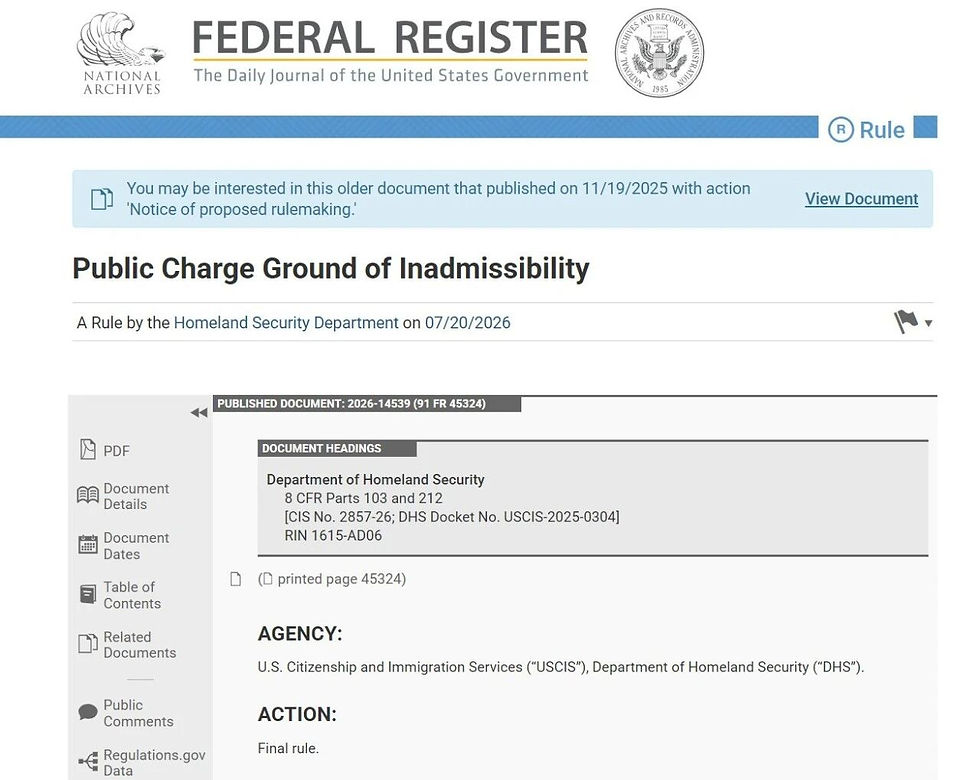
1. Understanding Public Charge Inadmissibility
Under the Immigration and Nationality Act (INA), an individual deemed "likely to become a public charge" at any time is inadmissible to the United States. This determination can lead to the denial of a visa, entry, or adjustment of status (Green Card).
Public charge evaluations apply primarily to:
Family-based immigration applicants
Employment-based immigration applicants
Select nonimmigrant visa applicants under specific circumstances
While the INA does not explicitly define "public charge," it requires officers to evaluate an applicant’s likelihood of future dependence on public assistance based on the totality of circumstances.
2. Expanded Factors in Adjudication
Under the updated framework, officers will continue to assess the mandatory statutory minimum factors:
Age
Health status
Family status
Assets, resources, and financial standing
Education and occupational skills
Additional Review Criteria
In addition to the mandatory statutory criteria, the new rule authorizes officers to consider:
Applications for or approval of "means-tested public benefits" (even prior to actual receipt).
Past or current receipt of government assistance.
General evidence demonstrating financial self-sufficiency.
Other discretionary factors deemed relevant to future financial independence.
Key Distinction: The new rule does not employ a rigid scoring system, nor does a single positive factor automatically offset a negative one. Adjudication remains discretionary and case-by-case. Prior benefit use does not trigger an automatic denial; conversely, applicants with no history of benefit usage may still face heightened scrutiny if they demonstrate limited financial reserves, heavy family financial burdens, or unstable income.
3. Scope of "Means-Tested Public Benefits"
Under the revised framework, "means-tested public benefits" encompass assistance programs that require applicants to demonstrate low income, low assets, or financial hardship.
Examples of benefits within the scope of review include:
SNAP (Supplemental Nutrition Assistance Program)
Medicaid (all categories)
CHIP (Children’s Health Insurance Program)
Housing subsidies and rental assistance
Nutritional assistance programs
Subsidies for medical testing, vaccines, or specialized grants
Adjudicators may review whether an applicant currently receives these benefits, has received them in the past, or has been formally certified as eligible.
4. Exempt Populations
Certain humanitarian categories remain exempt from public charge determinations, including:
Refugees and Asylees
T and U Visa holders
VAWA (Violence Against Women Act) self-petitioners
Note: If an exempt individual later seeks entry or adjustment under a non-exempt category, prior receipt of public benefits may become subject to review.
5. Public Charge Bonds: Heightened Breach & Cancellation Standards
If an applicant is inadmissible solely on public charge grounds, DHS may—at its sole discretion—allow the applicant to post a Public Charge Bond. Posting a bond is not a statutory right and remains entirely discretionary.
Terms for Bond Breach (Effective Sept 18, 2026)
For bonds posted on or after September 18, 2026, a breach occurs if the bonded individual:
Receives any income- or asset-tested public benefit during the validity period.
Violates any specific term or condition set forth in the bond agreement.
Upon a breach, the bond may be forfeited. Bonds posted prior to September 18, 2026, remain subject to the previous standards (which focused primarily on cash assistance for income maintenance and long-term institutional care).
Strict Cancellation Criteria
The new rule eliminates the discretionary provision allowing bond cancellation simply because USCIS determines the individual is no longer likely to become a public charge. Going forward, a bond can generally only be canceled if:
The individual becomes a naturalized U.S. citizen.
The individual permanently departs the U.S.
The individual passes away.
The original bond is replaced by an approved substitute bond.
Five years elapse from the date of entry or adjustment of status without a breach occurring.
Key Takeaway
While past receipt of government assistance does not result in an automatic Green Card denial, the new rule significantly broadens the factors immigration officers may consider. Applicants should prepare thorough documentation demonstrating overall financial stability and self-sufficiency.
Further operational instructions will be published in the USCIS Policy Manual prior to the September 18, 2026 effective date.


Comments