


Legal Advisory: Understanding the Annual Asylum Fee (AAF) Requirement, Enforcement Limits, and Payment Procedures
Recently, our office has received numerous inquiries regarding the Annual Asylum Fee (AAF), including whether payment is currently required, how timelines are calculated, and how to pay if no formal notification has been received.
Below is an overview of the statutory basis for the fee, the impact of recent federal court litigation, and practical guidance for affirmative and defensive asylum applicants.
Background: What Is the Annual Asylum Fee?
Enacted under H.R. 1 (commonly referred to as the "One Big America Act") in 2025, the Annual Asylum Fee (AAF) is a recurring assessment imposed on pending asylum applications.
Unlike the initial Form I-589 application—which does not carry a filing fee—the AAF applies to any asylum application that remains pending after one year. The fee must be paid annually for each subsequent year the case remains open.
Current Rate: Originally set at $100, the fee is indexed annually for inflation. For Fiscal Year 2026, the required fee is $102.
Fee Waivers: Under current guidelines, fee waivers or reductions for the AAF are generally not available.
Current Status: Is Payment Required Right Now?
Yes. Applicants remain legally obligated to pay the Annual Asylum Fee.
On July 21, 2026, the U.S. District Court for the District of Massachusetts issued an emergency order in Venezuelan Association of Massachusetts v. USCIS (Case No. 1:26-cv-13038). While this order temporarily enjoined USCIS from enforcing specific severe penalties, it did not invalidate the fee itself nor stay the collection process.
Scope of the Preliminary Injunction
Under the court’s order, USCIS is currently prohibited from:
Denying an asylum application solely due to non-payment of the AAF;
Terminating employment authorization (EAD) based on unpaid annual fees; or
Initiating removal proceedings against an applicant solely for failure to pay the fee.
Key Takeaway: The court’s order provides temporary protection against default denials and EAD revocations; it does not eliminate the underlying legal requirement to pay. Applicants who fail to pay risk accruing delinquencies or facing enforcement action if the injunction is modified or lifted.
Who Must Pay the Fee?
The AAF requirement generally applies to two main categories of applicants:
Continuous Pending Cases: Applicants whose asylum applications remained continuously pending with USCIS or EOIR throughout the full fiscal period from October 1, 2024, to September 30, 2025.
One-Year Anniversary Rule: Applicants who filed Form I-589 after October 1, 2024, and whose cases have remained pending for 365 cumulative days.
For applicants in the second category, the initial fee becomes due on the one-year anniversary of the Form I-589 receipt date, and on that same date in each subsequent year the case remains open.
Action Required if No Payment Notice Is Received
Our office has observed several instances where applicants reached their one-year anniversary without receiving written or electronic payment notices from USCIS or the Executive Office for Immigration Review (EOIR).
Lack of notice does not exempt an applicant from the payment requirement.
We strongly advise taking the following proactive steps:
Check Online Case Status: Enter your Form I-589 receipt number into the official USCIS online case status tool to check for active AAF payment prompts.
Proactive Remittance: If your case meets the time criteria, we recommend submitting the payment proactively—even without a formal notice—to prevent administrative delays or future compliance issues.
Next Steps and Upcoming Developments
Further Judicial Rulings: The District Court is scheduled to issue a further determination on or before August 5, 2026, following full briefings by both parties.
Agency Guidance: USCIS and EOIR are expected to issue detailed administrative instructions clarifying how the order will be operationalized across field offices and immigration courts.
Payment Methods by Case Jurisdiction
1. Affirmative Asylum Applications (USCIS Jurisdiction)
If your Form I-589 is currently pending before a USCIS Asylum Office (i.e., you have not been referred to Immigration Court and are awaiting an interview or decision):
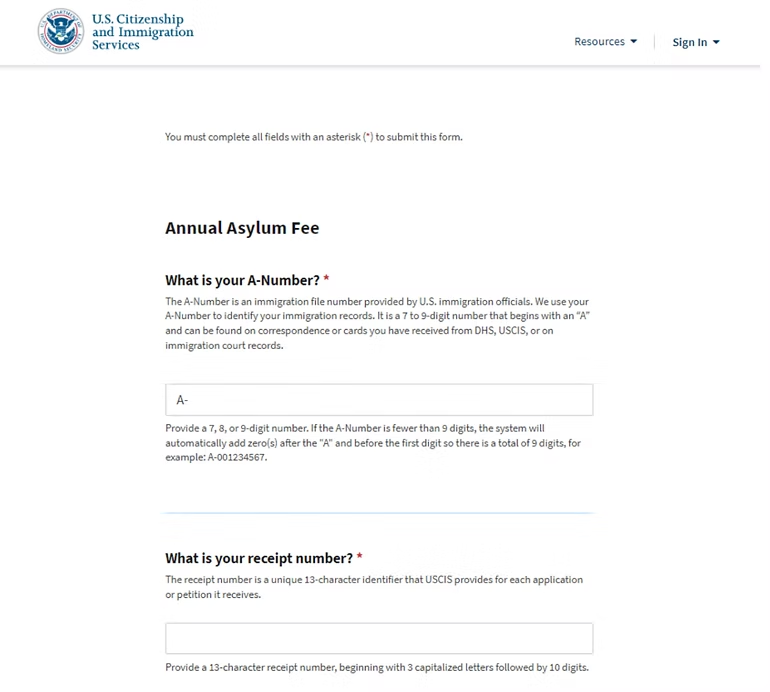
Payment Portal: Submit payments via the official USCIS Annual Asylum Fee Online System.
Required Information: You will typically need your Alien Registration Number (A-Number) and Form I-589 Receipt Number.
2. Defensive Asylum Applications (EOIR Jurisdiction)
If your asylum application is in removal proceedings before an Immigration Court or on appeal with the Board of Immigration Appeals (BIA):
Payment Portal: Submit payments through the EOIR Payment Portal.
Required Documentation: EOIR regulations require an Immigration Judge or the BIA to issue a formal written order specifying the exact amount and deadline. Payments must strictly follow the instructions set forth in the judicial order.

This advisory is provided for informational purposes only and does not constitute formal legal advice. If you have questions regarding your specific case timeline or payment status, please contact our office to schedule a consultation.


Comments