


New US Rules for International Students Implemented: Overstaying Indicates Unlawful Presence, Leading Up to a 10-Year Bar
Updated: Jul 29
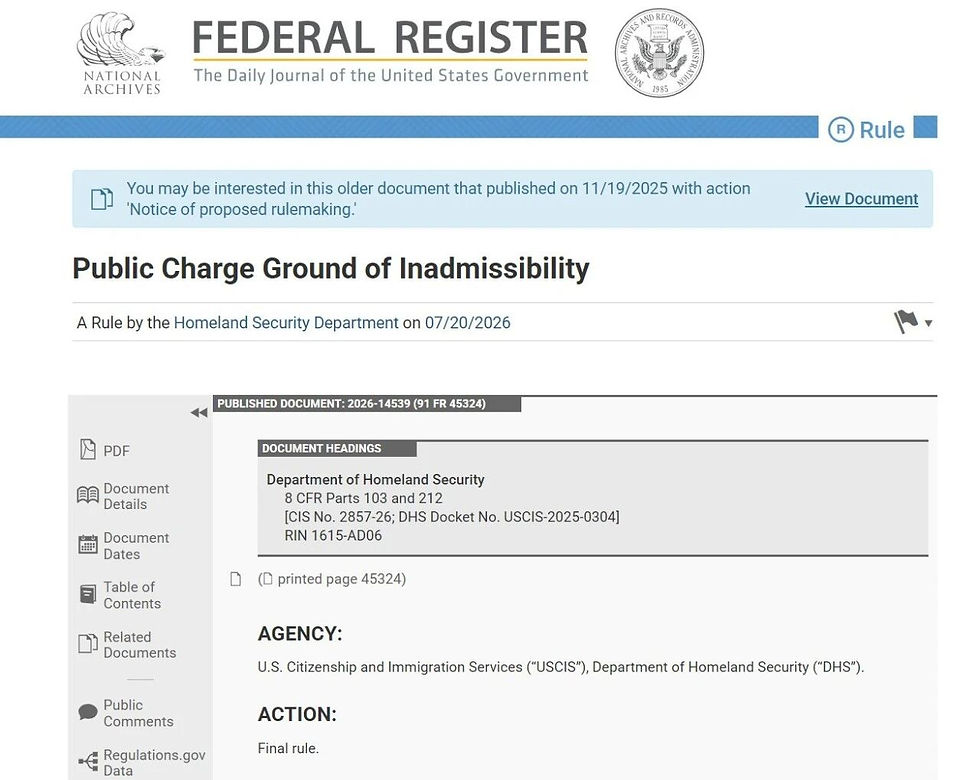
On July 17, the Department of Homeland Security (DHS) published a final rule eliminating the long-standing "Duration of Status" (D/S) policy for international students (F visa), exchange visitors (J visa), foreign news media representatives (I visa), and their dependents, replacing it with a fixed, explicit expiration date for authorized stay. Compared to the proposed rule published in August 2025, the overall changes in this final rule are minimal.

1. Elimination of D/S: Extensions Required Upon Expiration
Most nonimmigrants entering the United States are granted admission until a specific date. However, F, J, and I nonimmigrants have historically been admitted under "Duration of Status" (D/S).
What is Duration of Status?
For F-1 students: Typically the time needed to complete their academic program and OPT, plus a 60-day grace period.
For J-1 exchange visitors: Typically the time needed to complete their exchange program, plus a 30-day grace period.
For I-category nonimmigrants: Typically the duration needed to carry out assignments or related work for foreign media in the US.
Under the old D/S system, even if the study program or employment lasted longer than initially expected, F and J visa holders generally only needed their school or program sponsor to update Form I-20 or DS-2019 to remain legally in the US, without needing to file a separate extension application with USCIS. I-visa media personnel could also generally remain as long as they continued qualifying work.
Under the New Rule: If F, J, or I nonimmigrants need to remain in the US beyond their authorized period of stay—such as extending a program of study, extending employment, transferring schools, starting a new degree program, or initiating/extending post-completion OPT—they must file an Extension of Stay (EOS) application with USCIS and may be required to complete biometric collection.Note: If an existing F-1 student has an OPT or STEM OPT application pending when the rule takes effect, or files such an application within six months after the rule takes effect, they generally do not need to file a separate F-1 extension application.
2. New Limits on Period of Stay
The maximum authorized periods of stay under the new rule are as follows:
F-1 Students & Dependents: Maximum of 4 years, plus a 30-day grace period (the original 60-day grace period is reduced to 30 days).
J-1 Exchange Visitors & Dependents: Maximum of 4 years, plus a 30-day grace period.
I-Category Media Personnel & Dependents: Maximum of 240 days; maximum of 90 days for holders of Mainland Chinese passports.
3. Extension of Stay and Work Authorization
For F, J, and I visa holders who timely file an Extension of Stay application, certain work authorizations can be automatically extended while the application is pending.
4. Immediate Accrual of Unlawful Presence
Unlawful presence will begin accruing immediately once the authorized period of stay expires:
Accruing more than 180 days may result in a 3-year re-entry bar.
Accruing more than 1 year may result in a 10-year re-entry bar.
5. Transition Rules for Current Status Holders
Individuals holding valid F or J status when the new rule takes effect can generally remain until the expiration date of their current I-20, DS-2019, or OPT EAD card, up to a maximum of 4 years after the rule takes effect. Existing I-visa personnel can generally remain for up to 240 days (or up to 90 days for Mainland Chinese passport holders).
Note: If you need to remain in the US beyond the allowed transition period, you must file an Extension of Stay application in accordance with the new rule.
6. What Materials Are Required for an Extension Application?
A currently issued Form I-20 indicating that additional time is required to complete the academic program.
Evidence of compelling academic reasons (e.g., change of major, change in research topic, or unexpected research obstacles).
Medical documentation proving illness.
Other circumstances beyond the alien's control, such as natural disasters, national public health emergencies, or school closures.
7. Can You Depart the US While an Extension or Change of Status is Pending?
Departing the US while an Extension of Stay application is pending may adversely affect the application.
Departing the US while a Change of Status application is pending will generally cause the application to be deemed abandoned.
What Other Changes Are Included Besides Fixed Stay Periods?
1. Reduced Grace Period for F-1
Reduces the current 60-day grace period for F-1 students to 30 days. The timeframe for graduating students to leave the country, find a job, or apply to extend/change status will be significantly tightened.
2. Restrictions on Program and Major Changes for F-1 Students
Under the new rule, F-1 undergraduate students may not change their program, major, or educational level within the first year of their program unless the Student and Exchange Visitor Program (SEVP) approves an exception based on special hardship.
Special circumstances may include: School closure; Prolonged inability to attend classes due to a natural disaster; Necessary transfer to complete elementary or secondary education.
For F-1 graduate students, the new rule also strictly prohibits changing programs, majors, or educational levels in principle, though exceptions may still be permitted under special hardship circumstances.
Important: Students who have already completed a program at a given educational level will no longer be allowed to enroll in a program at the same or a lower educational level under F-1 status. The Day 1 CPT pathway, which relies on repeatedly enrolling in programs at the same or lower levels to maintain status, may be significantly restricted as a result.
3. Clarified Scope for I-Category Media Status
Foreign media organizations must have their headquarters located outside the United States and must regularly engage in collecting, producing, or disseminating news information. Activities primarily aimed at entertainment, such as participating in or appearing on reality shows, generally do not qualify for I-visa status.
4. Preservation of the "Deference to Prior Approvals" Policy
When processing I-129 extensions (such as for H-1B visas), if the applicant's employer, position, and other major facts have not undergone material changes, USCIS should generally defer to the previously issued approval decision rather than re-reviewing all eligibility requirements from scratch.
Effective Date & Summary
This rule is scheduled to take effect 60 days after its publication in the Federal Register. Because it is designated as a "major rule" subject to congressional review, Congress could still amend or disapprove it in rare circumstances; DHS will issue a separate notice in the Federal Register should any changes occur.
Overall, this new rule will fundamentally transform how F, J, and I nonimmigrants maintain their stay in the United States. Going forward, international students, exchange visitors, and foreign media personnel should pay much closer attention to their I-94 expiration date, program duration, and extension filing timelines to avoid unlawful presence, gaps in work authorization, or future status risks. Schools, program sponsors, and employers will also need to adjust internal procedures to ensure compliance well in advance.

Comments